
Saratoga Springs, NY · Garage Door Service
Why a Garage Door Goes Off Track Here
Saratoga Springs homes built 1938-2001 and severe winters push tracks out of line. Here's why it happens and what to do before the door jumps the rail.
- Repairs & new doors
- Springs & openers
- Serving 5 nearby communities
The Common Mistake
Most homeowners assume a door off its track means a bent rail, so they grab a rubber mallet and try to muscle it back into line. That's backwards. On the houses we work in around Saratoga Springs - a lot of them built between 1938 and 1956, the median year for this area - the track itself is rarely the first thing that fails. It's the roller, the hinge, or the bracket holding the track to the jamb. Hammer on a track that's only out of alignment because a roller seized up, and you'll bend metal that was fine to begin with. Then you're paying to replace a track you didn't need to touch. The mistake isn't noticing the door is off - it's treating the symptom instead of asking what pushed it there in the first place.
The Situation
With housing stock running 1938 through 2001 and a lot of it concentrated in the pre-1960 range across this part of the county, we see two different failure patterns depending on the build era. Older doors, the ones original or close to original on houses from the 1940s and 50s, often still run on steel track mounted with brackets that were never upgraded. Decades of expansion and contraction loosen those lag bolts a sixteenth of an inch at a time until the track walks away from the jamb under load. Newer installs from the 80s and 90s tend to go off track for a different reason - worn nylon rollers that stop rolling and start grinding sideways against the rail, walking the door off its line one cycle at a time. Both end the same way: a door that binds, chatters, or jumps the track entirely on the next cold morning.
How Local Conditions Play In
This region sits in a severe cold climate band, and that matters more for tracks than people think. Steel track contracts in the cold - enough that a bracket already loosened by age has less margin before it lets go. A door that was running a little rough in October can go off track entirely the first hard freeze, because the metal has pulled tighter against fasteners that were already marginal. We also see it after a quick swing the other direction - a January thaw that lets a slightly frost-heaved slab shift the floor track reference point by a fraction of an inch. On a door with original 1950s-era hardware, that fraction is enough. None of this is about the door being old for its own sake; it's the combination of original-era brackets and a climate that stresses metal hardware twice a year, freeze and thaw, instead of once.
Doing Nothing For Now
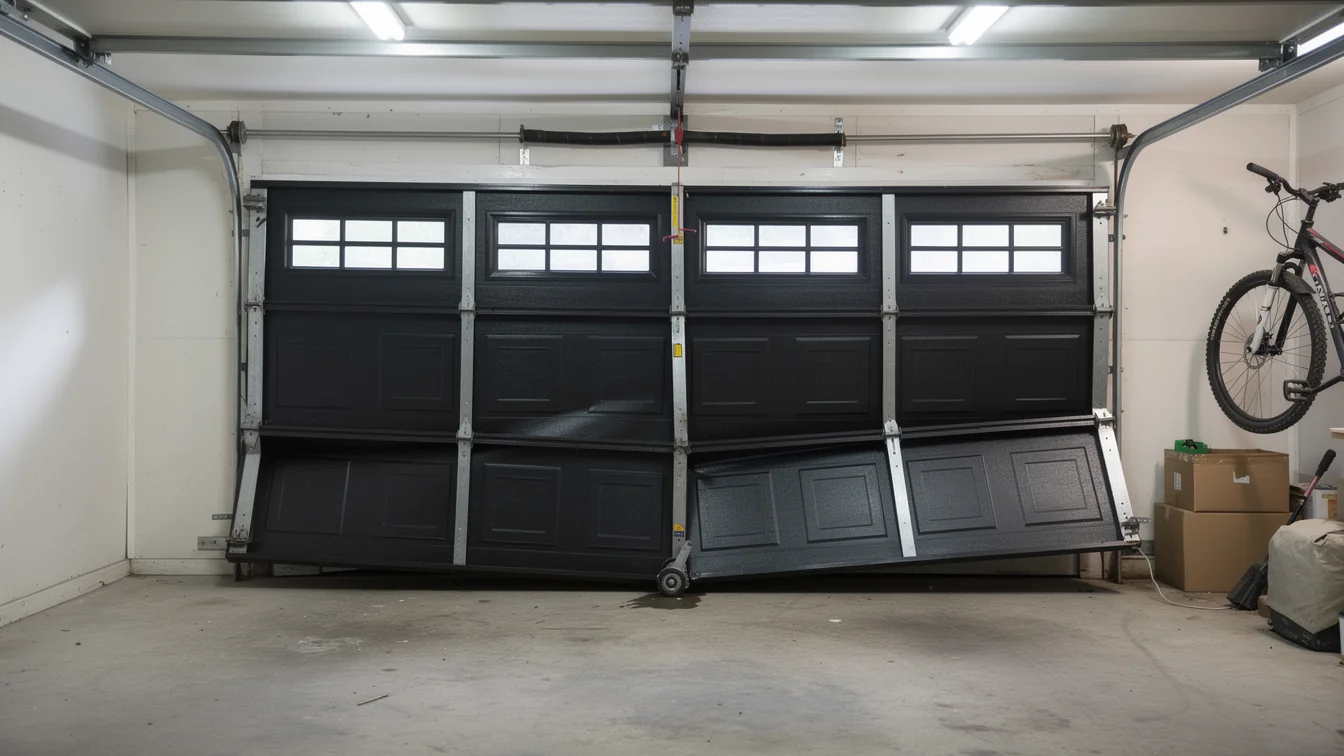
If the door is still opening and closing, even if it sounds rough, you don't have to drop everything. A door that's slightly off track but still cycling isn't an emergency - it's a call-this-week problem, not a call-tonight problem. Where you do need to stop using it is if the door is visibly tilted in the opening, if a cable has gone slack, or if it's chattering hard enough that you can see the track moving. At that point every cycle is doing more damage and risking a spring or cable failure on top of the track problem. One honest limit on our end: if the track and the bracket have both failed on an older house, we're usually recommending replacement of that section rather than a patch repair, because matching 1950s-era bracket spacing with new hardware is more labor than the parts are worth.
Frequently asked questions
Why did my garage door suddenly come off the track overnight?
On older Saratoga Springs houses, it's usually a bracket that's been loosening for years finally letting go once the steel track contracted in a hard overnight freeze. The cold doesn't cause the problem, but it's often what finishes it off.
Is it safe to drive my car out if the door looks tilted?
No. A visibly tilted door means a cable, roller, or bracket has already failed on one side. Forcing it open or closed can snap a cable or drop a panel. Leave it and call - this is one of the few garage door issues worth treating as urgent.
Will a new track fix the problem for good on an old house?
Not by itself. If your house has original 1940s or 50s hardware, the track usually fails because of worn rollers or loosened brackets, not because the track is bad. Replacing track without addressing the roller or bracket just buys you a shorter repeat of the same failure.
Related garage door services in Saratoga Springs
More garage door guides
Book garage door service in Saratoga Springs
Call now or request a quote - tell us what the door is doing and where you are.